Smarter water infrastructure for sustainable communities
Water supply is essential to healthy communities and regional liveability, but water systems are highly energy-intensive and costly to operate, creating an important sustainability challenge for local utilities. In collaboration with Shoalhaven Water, UOW researchers develop intelligent optimisation tools as a solution to help regional water utilities reduce energy use and improve the reliability of essential water services.
The initiative brought together artificial intelligence, real-time electricity market data, and practical engineering knowledge to support smarter operational decisions in water pumping systems. Through a web-based scheduling platform and coordinated control framework, the project helps operators better align energy-intensive processes with system needs and electricity market conditions. The work demonstrates how applied research can help regional utilities reduce operational pressure, improve infrastructure efficiency, and build more sustainable water services for the future.


Renewable Energy Zones for Power System Restart Service: A Feasibility Study
The Paris Agreement of 2015 outlined the actions nations must take to prevent the catastrophic effects of global warming. Following this, Australia has set legislated targets to reduce greenhouse gas emissions to net zero by 2050. Energy sector transformation is identified as a key priority for reducing greenhouse gas emissions. CSIRO's Rapid decarbonization scenario assumes renewable energy will have a share of more than 90% by 2030. The large-scale replacement of traditional coal-fired power stations with renewable energy sources will pose significant challenges for power system operation and control.
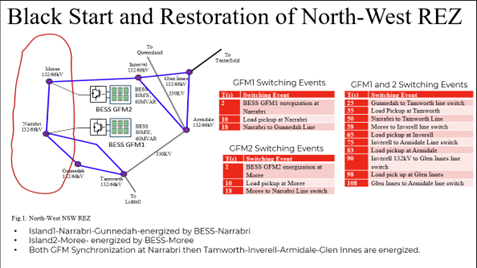
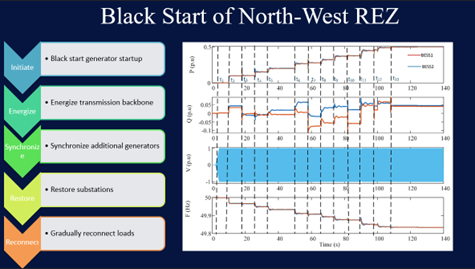
One of the major operational challenges in power systems is to re-energize the power network following major blackouts. Traditionally, coal-fired power plants have been the primary source of electricity generation. With these power plants being replaced, there is a need to study the feasibility of upcoming technologies such as battery energy storage systems and solar power plants as system-restart generating resources. In this regard, UoW, as part of CSIRO's AR-GPST Task 5 program, has conducted a feasibility study on the Northwest Renewable Energy Zone (REZ) as a black-start generator. At UoW, a simulation model of the Northwest REZ with various power network components, including grid-forming inverter-based Battery Energy Storage Systems, Transmission lines, transformers, PV power plant, and loads. A black-start and system-load restoration framework has been developed, and multiple case studies have been run to test its feasibility. The research outcomes include recommendations for inverter design, identified challenges that may arise when adopting new technologies, and future research directions.